Higher trust, faster decisions
Hover to reveal →
Personality tests tell you how someone works. We tell you why they work — and what they need from others to trust, collaborate and stay.
33,938 respondents across 28 countries reveal a values-trust crisis hiding inside every team.
of people globally are hesitant or unwilling to trust someone with different core values.
would switch departments rather than report to a manager with different values.
say distrust of those with different values must be addressed urgently.
Decades of research — from Schwartz's values theory to organisational culture studies at Harvard, Gallup and Deloitte — point the same way: when people share core values, performance, retention and wellbeing rise together.
Hover to reveal →
Higher trust, faster decisions
Teams with shared values report stronger psychological safety, enabling quicker consensus and lower coordination cost (Edmondson, HBR).
Hover to reveal →
Stronger retention
Employees whose personal values match their employer's are far less likely to leave — culture fit predicts tenure better than pay alone (Gallup, MIT Sloan).
Hover to reveal →
Better engagement & wellbeing
Values congruence is consistently linked to higher engagement, lower burnout and better mental health at work (Schwartz; Deloitte Human Capital).
Hover to reveal →
More productive collaboration
Shared values reduce friction in cross-functional work, lifting team performance and innovation output (Katzenbach Center, Strategy&).
Hover to reveal →
Customer loyalty follows
Organisations whose people live consistent values deliver more coherent customer experiences — a key driver of loyalty and advocacy (Edelman Trust).
Hover to reveal →
Resilience in change
Aligned cultures absorb restructures, mergers and market shocks better, because decisions stay anchored to a shared 'why' (McKinsey Organisational Health Index).
Sources synthesised from Schwartz (1992, 2012) Theory of Basic Human Values; Edelman Trust Barometer 2026; Gallup State of the Global Workplace; Deloitte Human Capital Trends; McKinsey Organisational Health Index; Edmondson, Harvard Business Review.
MBTI, DISC, Big Five — they were never designed to measure what matters most: whether people share the beliefs and motivations that underpin trust.
Personality asks "How do you prefer to work?"
We ask "What do you believe matters most?"
| Personality | Values Index® | |
|---|---|---|
| Measures | Behavioural traits | ✓Core beliefs & drivers |
| Predicts | How someone works | ✓Who they trust |
| Stability | Shifts with context | ✓Stable over time |
| Culture fit | Surface compatibility | ✓Deep alignment |
| Evidence | Varies by tool | ✓82 countries · 60k+ |
| Trust insight | Not measured | ✓Core purpose |
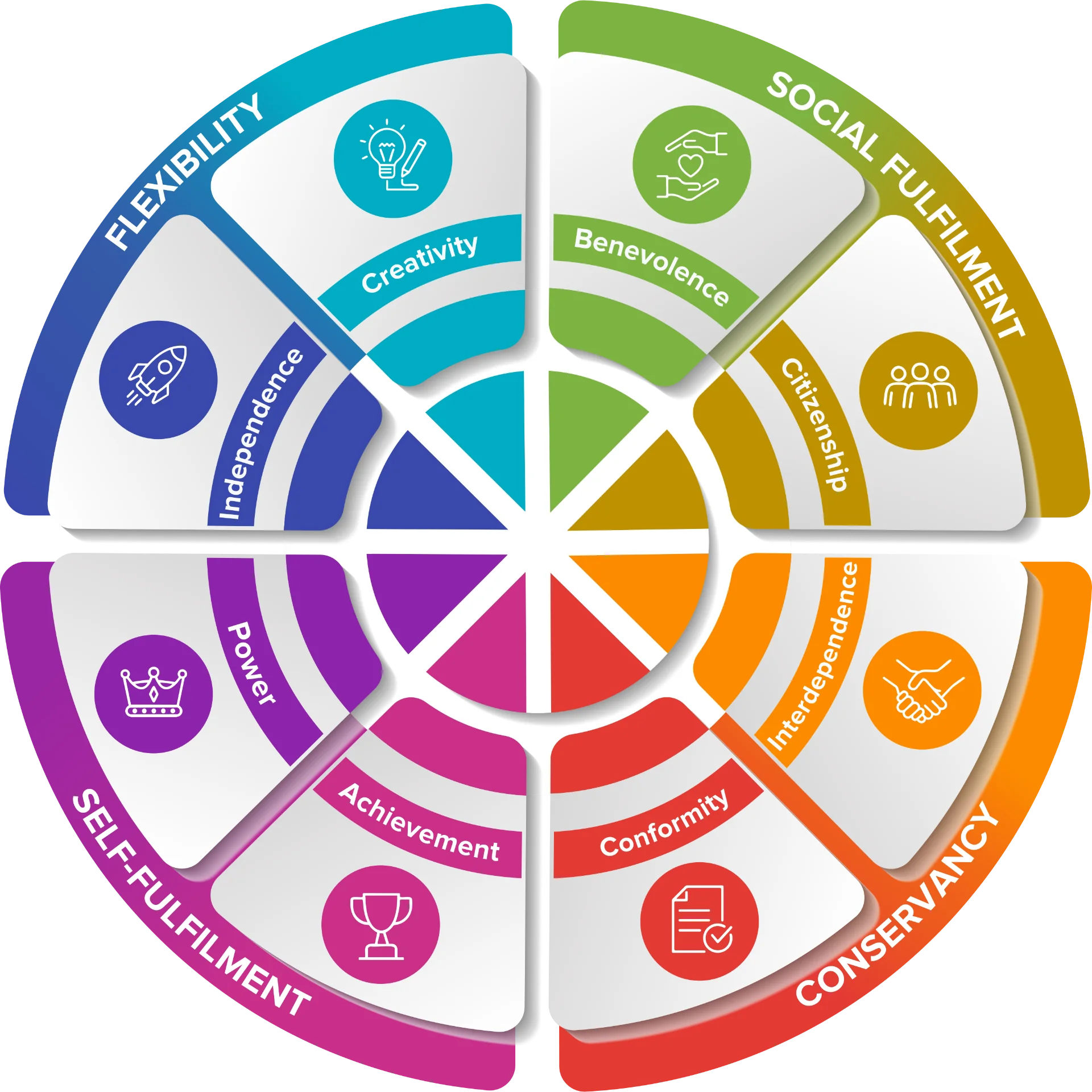
Four orientations · Eight values
Tested across 82 countries with 60,000+ people — one of the most extensively validated frameworks in cross-cultural psychology.
Hover over any value to see what it means.

Flexibility
Creativity
Creativity
Freedom to think independently, explore new ideas and shape your own path through curiosity and originality.

Flexibility
Independence
Independence
Acting autonomously, choosing your own goals and trusting your own judgement over external direction.

Social Fulfilment
Benevolence
Benevolence
Caring for the wellbeing of those close to you — loyalty, honesty and genuine helpfulness within your circle.
Social Fulfilment
Citizenship
Citizenship
Concern for all people and the planet — fairness, equality and social justice that reach beyond your own group.
Conservancy
Interdependence
Interdependence
Honouring shared customs and the wisdom of community; finding meaning in continuity, belonging and tradition.
Conservancy
Conformity
Conformity
Restraining impulses that could upset others; respecting expectations, social norms and people in authority.

Self-Fulfilment
Achievement
Achievement
Demonstrating competence and earning recognition through visible success against shared standards.

Self-Fulfilment
Power
Power
Influence over people and resources; pursuing status, control and the material rewards that come with them.
Values that sit adjacent on the wheel are complementary — people who hold them tend to collaborate naturally. Values on opposite sides can create tension unless actively managed.
01
Assess Values Orientation
Each person completes a short, validated assessment and receives a personal values report.
02
Analyse Values Alignment
Access a live dashboard to compare alignment between people, teams and candidates.
03
Act with Confidence
Hire for fit, design cohesive teams, develop values-aware leaders.
HR & People Leaders
Design retention, leadership and wellbeing strategies grounded in what your people actually care about.
Talent Acquisition
Go beyond CV screening. Assess values fit before the offer — not after the exit interview.
OD Specialists
Map values alignment across departments, functions and leadership layers.
Take a survey
Three entry points — for organisations measuring alignment, recruiters benchmarking candidates, and individuals exploring their own values.
Already onboarded?
Sign in to your live Values Alignment dashboard.
Independently validated
The Values Alignment Index® has been independently reviewed by a Chartered Occupational Psychologist and specialists in psychometrics, who have confirmed it accurately measures human values and values alignment — and meaningfully predicts behaviour and performance shaped by those values.
"The Values Alignment Index® is a great way of digging deeper into what makes you — and others — tick. This allows everyone to play to their strengths and avoids potential misunderstanding."
"Values are key determinants of how we think, feel and work together. This index gives managers a new way to measure and understand the prevailing value orientation of their teams — and crucially, how to use it to enable a more productive, supportive working environment."
Get started
Starter
10 assessments (ex VAT)
Includes full access to the Values Alignment Dashboard. Assess alignment between and within teams, and benchmark candidates against your existing culture.
Growth
50 assessments (ex VAT)
Includes full access to the Values Alignment Dashboard. Assess alignment between and within teams, and benchmark candidates against your existing culture.
Enterprise
100 assessments (ex VAT)
Includes full access to the Values Alignment Dashboard. Assess alignment between and within teams, and benchmark candidates against your existing culture.
Just create an account, choose your package and get started. Need more licences or a bespoke plan? Get in touch.
FAQs
It's a fair question. Most tools promise insight. Fewer genuinely change how organisations think, decide and operate. These are the questions we're asked most — and the answers we believe stand up to scrutiny.
Resources
Download your personal signature banner and explore how the 16 Values Alignment archetypes relate to one another.